
Collaborating with Reality

People keep sending me Roosevelt.
The quote arrives in my inbox. It gets brought up in meetings, in casual conversations. Friends text it to me late at night.
“It is not the critic who counts… the credit belongs to the man who is actually in the arena, whose face is marred by dust and sweat and blood; who strives valiantly; who errs, who comes short again and again, because there is no effort without error and shortcoming…”
I know why people send it.
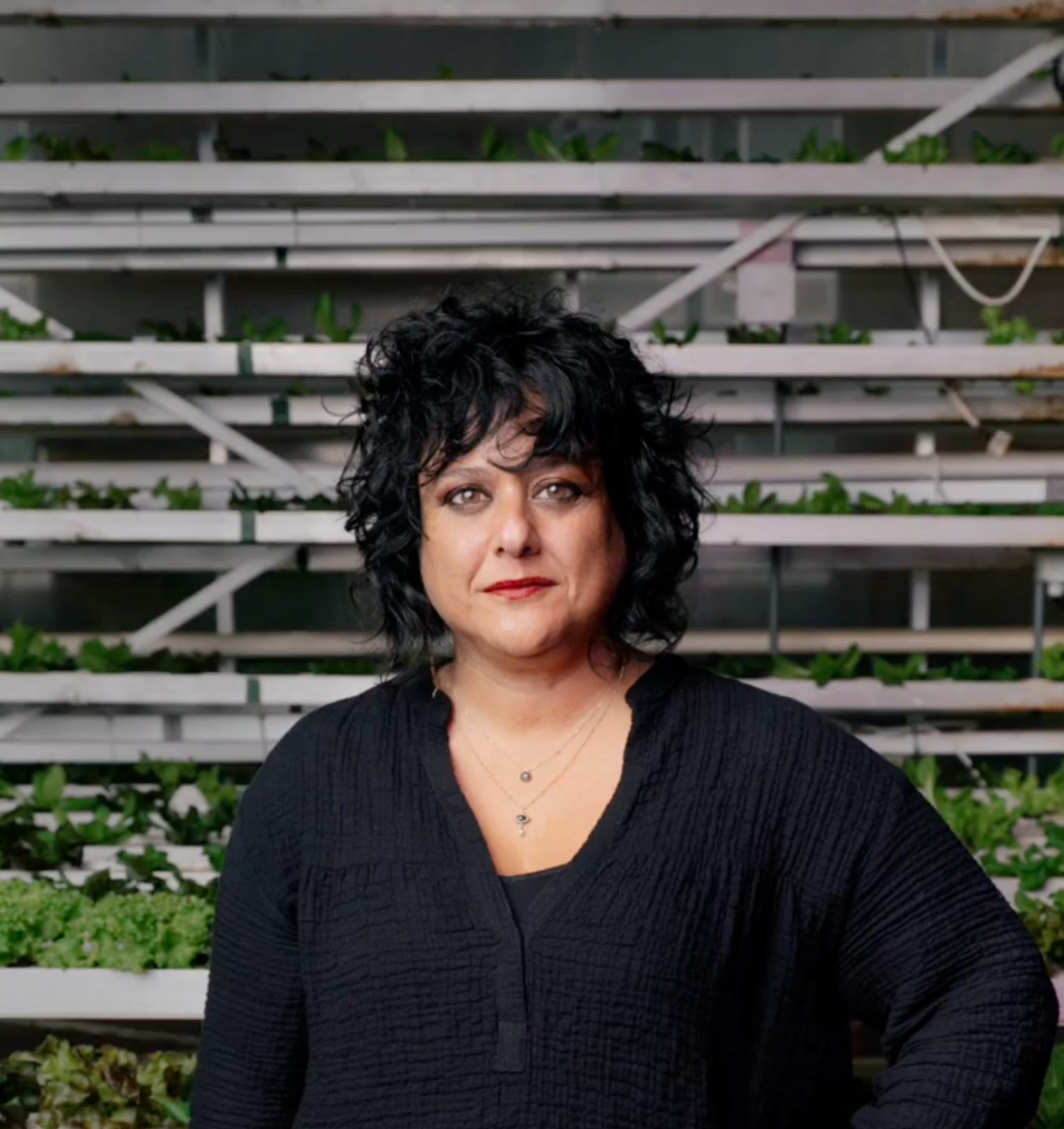
I am building something real, with my bare hands, with my co-founder, with a team I love. The dust is on us.
The vertical farms are real too. Both of them. Both feed communities by growing greens in February. Both employ people the labor market was not designed to employ. Both exist because people from across the aisle came together to build them.
The food and the jobs are not two projects. They are one design.
Anyone who walks into one of these farms feels it immediately. People feel the possibility. And possibility changes people too.
I love Roosevelt’s speech. It refuses the easy refuge of cynicism. It gives dignity to trying. To striving. To failing publicly while attempting something difficult. But lately I have been thinking the speech does not quite name something.
What if the real work of the arena is not domination, but relationship?
This week I listened to Pema Chödrön speaking with Ezra Klein. She used a phrase from one of her teachers that I have not been able to let go of.
Collaborating with reality.
Working with what is actually there instead of exhausting yourself arguing with it. That phrase unlocked something for me.
There has been a growing call lately for builders. For people working in atoms, not just bits. For people building real things in the physical world: infrastructure, food systems, manufacturing, housing, energy.
Atoms matter. They feed people. They give people work to do at six in the morning. They cannot simply be deleted, optimized into abstraction, or pivoted into something else next quarter.
But what people do not say loudly enough about building in atoms is that it is hard, it takes longer than expected, and atoms do not bend. Not the laws of physics. Not the climate. Not the economics. Not the people.
You work with what is actually there, or you do not build.
That is what I have slowly come to understand about Vertical Harvest.
The work was never about domination over difficult conditions. It was never about forcing Wyoming to grow food. Or forcing a labor market to become inclusive. Or forcing finance into a shape it did not recognize.
It was always collaboration.
We engineer the ecosystem plants need to thrive. We design jobs around the people who hold them. We build with the financing tools that exist, imperfect as they are. We adapt to weather, labor, markets, politics, biology, human emotion.
We collaborate with reality.
The old system, by contrast, still sees mostly in binaries. Profitable or not profitable. Charity or enterprise. Operational rigor or compassion.
The company we built was never going to fit neatly into those categories. It is operationally rigorous and mission-driven. It is economically ambitious and deeply human. The social outcome is not separate from the business outcome. They are the same outcome.
That is the whole point.
As the model has been tested publicly, one criticism keeps resurfacing: they only got funding because it was a social mission.
I want to be clear. We received a USDA-backed loan because the business model fit the metric. Because there was market demand. Because we had ten years of operational data. Because the underwriting was rigorous.
The mission was not charity layered onto a weak business. The mission strengthened the business.
The arena is public. If it is not public, it is not the arena. If I stay quiet about what I am learning, the work stays private. The model stays opaque. The people who might understand it never find it. That is part of what building something new actually is. Years of conversations. Hundreds of pitches. Walking people through farms in the middle of winter trying to help them see something that does not fully exist yet. Most people cannot. A few can immediately. Those people change everything.
So I am trying to live honestly inside the process. Not after it. During it.
The polished version of innovation is always cleaner than the reality. The reality is confusion. Translation problems. Systems struggling to recognize something they do not yet have language for.
I brought in people who had spent careers inside legacy systems. In some places it translated seamlessly. In others, it did not. Not because they lacked skill, but because the model itself did not fit existing categories.
That is part of what makes innovation hard. There is no real playbook for what has not yet existed.
We built through federal innovation frameworks because the model met the criteria and the opportunity aligned. Maybe my mistake was believing systems built on binaries would immediately know what to do with a model built on integration.
I still do not fully know the answer to that. But I know this.
If I had not believed it was possible, none of this would exist. Not the farms. Not the jobs. Not the food. Not the people standing beside me now.
This week Pema also gave me another phrase I cannot stop thinking about.
Lean into the sharp points.
When something hurts, when something feels uncertain, when something exposes your limits, do not flee from it. Stay with it. Learn from it. I am trying.
It is not glamorous. It is learning to sit with uncertainty publicly. It is leading through a chapter I did not script. It is watching a model I deeply believe in be tested in real time while people debate its legitimacy from a distance.
But I am beginning to understand that this too is part of the work.
The arena is not simply where you get bloodied. It is where you continue collaborating with reality while the world watches. It is where you work with the actual conditions in front of you instead of the fantasy version you wish existed. And reality is not clean.
Reality is people. Reality is payroll. Reality is lenders. Reality is lettuce. Reality is disability. Reality is markets. Reality is ego. Reality is hope. Reality is limitation. Reality is care.
You do not dominate those things. You work with them.
The old systems spend enormous energy arguing with reality.
Insisting a company must be either impact or investment. That a worker either fits the slot or does not. That food must be either commodity or charity.
We never had the luxury of that kind of rigidity. We had to build with what was actually true.
Here is also what I am learning. Leaning into the sharp points is not only about staying in the pain. It is about learning from it. Trusting that the struggle itself may be making space for a new way forward.
That trust is what keeps me in it.
I have watched people walk through our buildings and immediately understand what is possible. I keep building for them.
So when people send me Roosevelt, I take it in. The striving. The public risk of caring deeply about something uncertain.
But I want to add this. The arena is where you lean into the sharp points. With your bare hands. With the math. With the body you are in. With the people beside you.
I am collaborating with reality. Leaning into the sharp points. Living with my mistakes. The work continues. The dust is on me.
I would not be anywhere else.
The conversation between Pema Chödrön and Ezra Klein was incredible to listen to. I highly recommend it.
And if this topic intrigues you, here are a few places to keep going with Pema’s work.
Comfortable With Uncertainty. A book about what to do when you do not know what comes next.
When Things Fall Apart. Exactly what the title says.
Welcoming the Unwelcome. How to lean into the sharp points.
Another Kind of Freedom. Her newest, and the source of the two phrases above.
Loved this conversation with Ezra and Pema Chodron. Love you too, and everything you are working to do... change the paradigm of what is possible, what is worthy, and what is "success."
Sending love and courage. You got this!