
Where Coherence Comes From

People talk a lot about the universe and frequency.
I don’t dismiss that language anymore. There is so much we don’t understand, and I’m increasingly aware of how limited our perception really is. My brain, like most of ours, can’t actually see what’s happening beneath the surface of things.
Many of us have been searching for patterns as a way of dealing with this moment. Trying to name what’s breaking. Trying to understand why so many systems feel brittle at once.
And yet, there is something real underneath what people are reaching for.
What I see, again and again, is not the universe responding to attitude, but systems responding to coherence.
Every system has thresholds. Bodies do. Organizations do. Cities do. Food systems do. When inputs arrive too fast, too hard, or too disconnected from meaning, systems don’t become more efficient. They collapse into survival.
That collapse is often moralized after the fact. We call people irrational, polarized, greedy, broken. But much of what we’re witnessing is regulatory failure: nervous systems overwhelmed, institutions pushed past their capacity, feedback loops no longer holding.
This is the part that often gets mislabeled as “frequency.”
What people are sensing is state.
When a nervous system is regulated, perception widens. Options appear. Timing improves. When a nervous system is overloaded, everything narrows. Thinking becomes binary. Decisions become defensive. Survival replaces imagination.
That’s true for individuals. It’s also true for groups. Rooms have nervous systems. So do organizations. So do cities.
What we call “systems” are, at their core, networks of people regulating one another moment by moment. Which is why coherence doesn’t originate inside a single person.
It happens between us.
We are humans first, long before we are roles or positions. Our nervous systems evolved in relationship. We borrow steadiness from people we trust and offer it back without thinking about it. Coherence is not a personal achievement. It’s a relational state. It’s what happens when people feel seen, heard, and unthreatened enough to think together. Human connection isn’t a soft overlay on systems; it’s the infrastructure that keeps them from collapsing.
You know this feeling.
It’s what happens when you’re with people you trust. Sitting around a table. Cooking together. Talking without performing or proving anything. No one is managing the room. No one is scanning for threat. There’s a glow in those moments—not because nothing can go wrong, but because your body stops bracing. Your shoulders drop. Your breath deepens. Time stretches just enough to let you feel where you are.
For a while, the world feels workable.
Nothing feels brittle. Nothing feels urgent in the wrong way. You’re available. You can listen. You can laugh. You can think a few steps ahead without fear snapping everything shut.
That sense of safety isn’t sentimental. It’s physiological, and it’s created in relationship. It allows curiosity to return. It gives imagination room to re-enter. It makes risk feel possible instead of dangerous.
That is coherence, experienced from the inside.
When enough people feel it at once, systems behave differently. Conversations soften. Time opens up. Decisions stop being purely defensive. Possibility returns, not because the facts changed, but because the system stopped protecting itself from reality.
This is why leadership is less about vision than we like to admit, and more about regulation.
I’ve learned this by watching myself lead. Leaders are regulators, whether we intend to be or not. Not because we control others, but because our state sets the conditions in the room. We pace inputs. We shape attention. We either amplify fear or create room for clarity.
When I carry the weight of a moment in my body, everyone feels it. My urgency tightens the room. Conversations shorten. Options disappear.
When I steady myself first, the opposite happens. The system reopens. Momentum returns, not because the facts have changed, but because people can think again. Under real pressure, I can feel the fork in the road: whether I transmit strain or help the room find its footing. That choice matters.
Fear spreads. Calm spreads. Clarity spreads. So does numbness.
When people say “the universe responds,” what they’re often noticing is this: when we change our internal state, we change the system we’re inside. Different signals go out. Different responses come back. Different options become available.
That’s not magic. That’s biology, attention, and social physics.
This is where food enters the conversation, not as metaphor, but as structure.
Food is one of the few systems that touches everything at once: biology, culture, labor, economics, infrastructure, care. Food regulates nervous systems. It creates rhythm. It slows time. It stabilizes households. It reduces background stress.
When food systems are local, dignified, and reliable, they free cognitive bandwidth. People can think beyond survival. When food systems are extractive, fragile, or distant, they add constant, low-grade stress to everyday life.
Food doesn’t just sustain life.
It coordinates systems.
This is why food belongs in conversations about leadership, coherence, and the future of our cities. It’s one of the most powerful regulatory tools we have, and we’ve treated it as either commodity or sentiment for too long.
If we want different outcomes, we have to stop asking people to be better inside broken systems. We have to design systems that can hold human nervous systems without breaking them. Systems that feed rather than extract. Systems that stabilize rather than overwhelm.
That is the work. Not manifesting. Not bypassing. Not hardening. But building the conditions for coherence, again and again, at every scale we can touch.
And sometimes, that work begins exactly where it always has: around a table, with people we trust, sharing food that gives our bodies enough safety to believe, if only for an evening, that the world can still hold.
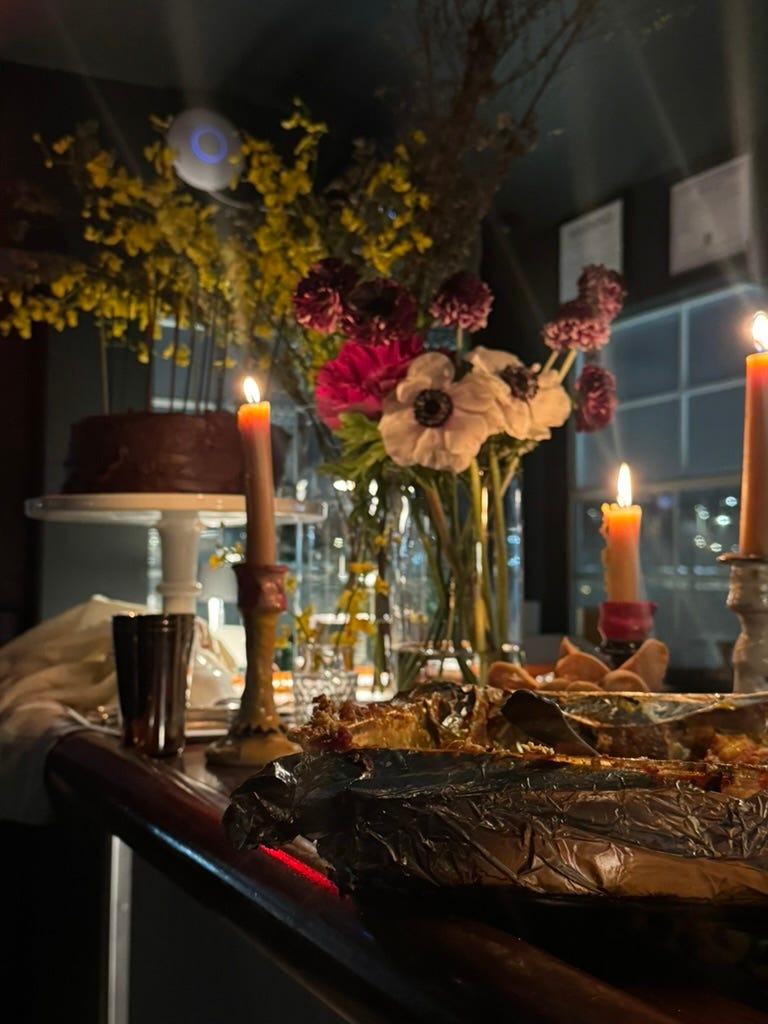
And this is where the work gets practical.
Coherence doesn’t live in ideas alone. It has to land somewhere. Often, it lands at the table.
This is what we make when we need the world to feel workable again. It simmers slowly. The house fills with lemon, olive oil, and herbs. It gives our bodies enough safety to settle so we can talk, laugh, and think a little more clearly.
Nothing fancy. Nothing performative. Just food that regulates.
Mediterranean Lemony Chicken and Rice Soup with Herbs
Bright, savory, and generous with lemon. This soup should taste like it’s been sitting in the sun.

Ingredients:
1 whole chicken, or 2–3 pounds bone-in chicken thighs
3 tablespoons good olive oil
1 large yellow onion, finely chopped
3 carrots, sliced
3 celery stalks, sliced
5 cloves garlic, smashed
1 cup short-grain rice (arborio or medium-grain works beautifully)
2 teaspoons kosher salt, plus more to taste
Freshly ground black pepper
1 bay leaf
1 small bunch fresh dill, finely chopped
1 large bunch fresh parsley, finely chopped
Optional: a small handful of fresh oregano or thyme
Zest of 2 lemons
Juice of 3–4 lemons (don’t be shy)
Method:
Warm the olive oil in a large pot over medium heat. Add the onion, carrots, and celery with a pinch of salt. Cook slowly until soft and fragrant, letting everything sweat without browning. Add the garlic and cook for another minute.
Add the chicken, rice, bay leaf, and a few herb stems if you have them. Season with salt and pepper. Pour in enough water to cover everything by about two inches.
Bring to a gentle boil, then reduce to a steady simmer. Let it cook uncovered for 45–60 minutes, until the chicken is tender and the rice has softened and lightly thickened the broth.
Remove the chicken, shred the meat, and return it to the pot. Stir in the lemon zest, then start with the juice of three lemons. Taste. Add more lemon and salt until the broth is unmistakably bright and alive.
Turn off the heat and stir in the chopped herbs at the very end. The soup should smell green and fresh.
Finish with a generous drizzle of olive oil.
Serve hot. With bread. With people you trust. With time.
This is food that steadies and wakes you up at the same time. Bright without urgency. Grounded without heaviness.
Which is often where coherence begins.
Excellent example for my upcoming workshop on conflict transformation and facilitation and a question I think I'll offer up to the participants is what is an external driver - to think of what is the driver coordinating a system where conflict has settled and can we re-educate ourselves on taking a new look at how the system is characterized? Just like you proposed with food systems -- rather than as "a sentiment or commodity" but "as a powerful regulatory tool" I love how your brain works. love love love ya. And, now to cook the soup!!!!